
Working Capital: The Hidden Engine Behind Business Stability

Most business owners focus on profit. Fewer focus on working capital. Yet working capital is often the true engine behind operational stability. Working capital represents the difference between what your business owns in the short term (cash and receivables) and what it owes in the short term (payables and expenses). It determines whether daily operations […]
Financial Workflow Review: When Was the Last Time You Examined Your Processes?
Most businesses review financial results regularly. Fewer review the processes that produce those results. A financial workflow review examines how transactions move through the organisation — from invoicing to reconciliation to reporting. Over time, processes evolve informally. New software is added. Responsibilities shift. Workarounds develop. What once functioned efficiently may gradually become inconsistent. Without review, […]
Manual Processes vs Automated Systems: Where Is Your Business Losing Time?
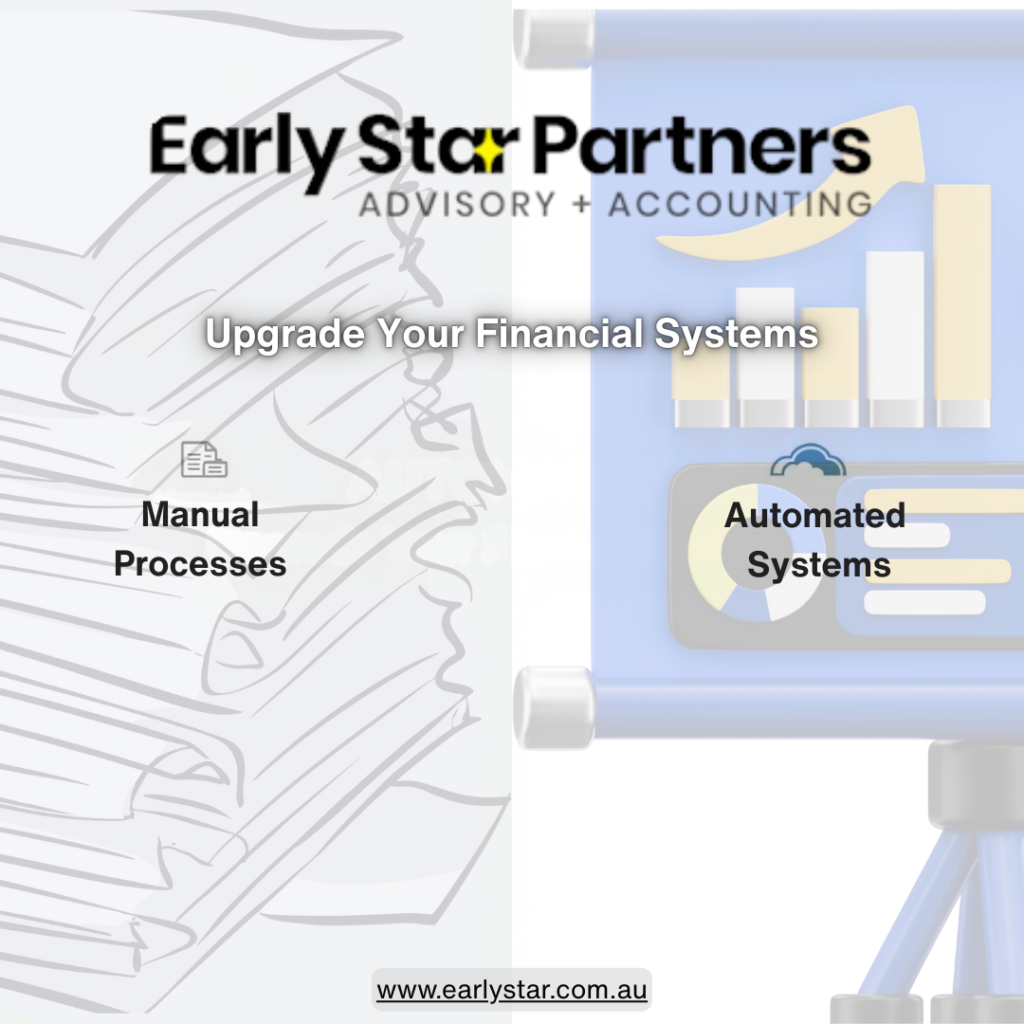
Many businesses still rely heavily on manual finance processes. Spreadsheets are updated by hand. Invoices are reconciled manually. Payroll adjustments require repetitive intervention. While these methods may function initially, they rarely scale efficiently. Manual processes increase risk. They rely on individual memory, increase the likelihood of error, and delay access to accurate reporting. As business […]
Operational Efficiency: The Financial Advantage Most Businesses Overlook
Operational efficiency is often discussed in terms of productivity, staffing, or workflow improvements. However, its financial impact is frequently underestimated. Efficiency directly influences profitability. When internal processes are disorganised or manual, businesses lose more than time. They lose visibility, margin control, and strategic capacity. Small inefficiencies — duplicated tasks, inconsistent expense coding, manual reconciliations — […]
Profit vs Cash Flow: Why Understanding the Difference Prevents Financial Stress

One of the most common sources of confusion for business owners is the difference between profit and cash flow. A business may show a strong profit on paper yet feel financially tight in practice. This disconnect can create uncertainty and frustration, particularly when revenue appears steady. Profit reflects performance over a defined period. It includes […]
Understanding Gross Margin: The Metric That Protects Growth

Gross margin is one of the most powerful — and misunderstood — financial metrics. It measures the difference between revenue and the direct costs required to deliver that revenue. When gross margin is strong, businesses have flexibility. When it weakens, every decision becomes tighter. Growth without margin discipline is dangerous. Why Gross Margin Matters in […]
Revenue Is Vanity, Profit Is Strategy: Understanding True Business Performance

Revenue growth is often celebrated as the primary indicator of business success. Increasing turnover feels like progress. Sales targets are achieved, client numbers expand, and activity levels rise. However, revenue alone does not determine financial strength. Many Australian businesses experience growth in turnover while profitability quietly declines. This usually happens when rising operational costs, inefficient […]
Preparing for the Next Quarter: A Strategic Financial Reset

As February concludes, attention naturally turns toward the next quarter. Quarterly financial planning is one of the most underutilised strategic tools available to business leaders. Rather than waiting for end-of-year reflection, quarterly resets allow businesses to: It creates momentum without waiting for a full financial cycle to conclude. Why Quarterly Review Matters A structured quarterly […]
From Reactive to Proactive: Strengthening Financial Decision-Making

Many businesses operate in reactive mode without realising it. Decisions are made in response to immediate pressures — a large expense, an unexpected dip in cash flow, a regulatory requirement, or a hiring need. While occasional reactive decisions are unavoidable, consistent reactivity signals a structural gap. Proactive financial decision-making changes the tempo of leadership. The […]
Navigating the Australian Business Landscape in 2026: Stability Through Clarity

The Australian business landscape continues to evolve. While inflation has moderated compared to previous years, operational costs remain elevated. Wage growth, superannuation increases, and regulatory complexity continue to shape the financial environment for many organisations. For business owners, the challenge is no longer crisis response — it is disciplined navigation. Stability in 2026 will not […]
Outsourcing Finance: A Smarter Alternative to Building an Internal Team

As businesses expand, financial administration inevitably becomes more demanding. Leadership often reaches a decision point: Should we hire internally, or outsource? While internal teams provide direct oversight, they also introduce fixed costs, recruitment time, and training requirements. Outsourcing offers flexibility. The Benefits of Finance Outsourcing Outsourcing finance functions provides: For many growing businesses, outsourcing provides […]
Hiring for Growth: The Financial Questions You Must Ask First

Hiring is one of the most significant financial decisions a business can make. While increased demand may justify expanding your team, employment commitments extend beyond salary alone. Superannuation, leave entitlements, payroll tax thresholds, and compliance obligations must all be factored into the equation. Growth through hiring should be calculated — not assumed. The True Cost […]