
The Financial Impact of Delayed Payments — And How to Manage It

Delayed payments are one of the most common — and underestimated — threats to business stability. A strong month of invoicing may create the appearance of financial health. However, when receivables extend beyond agreed terms, liquidity pressure builds quickly. In sectors where payment cycles are complex — including government-funded services, subcontractor arrangements, and large corporate […]
Risk Management in Business: Financial Planning Beyond Insurance

When business owners hear the term “risk management,” insurance policies are often the first consideration. While insurance plays a role in protecting assets, financial risk management extends far beyond coverage. Financial risk arises from multiple sources: Managing these risks requires structured financial planning, not simply protective contracts. Understanding Financial Exposure Every business operates with varying […]
Why Cash Reserves Matter More Than Revenue in Uncertain Times

Revenue often receives the most attention in business performance discussions. Growth targets, new client acquisition, and turnover milestones dominate strategic planning conversations. Yet during periods of economic uncertainty, revenue alone does not determine stability. Liquidity does. Cash reserves provide flexibility, resilience, and decision-making confidence in ways that revenue cannot. A business may generate significant income, […]
Why Break-Even Analysis Is More Important Than Ever

In uncertain economic environments, clarity around minimum performance requirements becomes increasingly important. Break-even analysis provides this clarity. At its core, break-even represents the revenue required to cover all operating costs — both fixed and variable. It defines the baseline from which profitability begins. Many business owners are familiar with the concept, yet few actively monitor […]
When Should You Review Your Pricing Strategy?

Pricing is one of the most powerful — and often most avoided — financial decisions a business makes. In stable economic conditions, pricing may remain unchanged for extended periods. However, in environments where operational costs gradually increase, holding prices static can silently reduce profitability. Many Australian businesses hesitate to review pricing because of concern about […]
Managing Rising Business Costs in Australia: A Strategic Approach

Australian businesses continue to navigate an environment where operational costs remain elevated. While economic headlines may shift focus, the practical reality for many organisations is steady upward pressure on wages, superannuation contributions, supplier pricing, insurance premiums, and energy expenses. The challenge is not simply that costs are rising — it is that margin pressure often […]
End-of-Week Financial Review: A Habit That Changes Everything

Many business owners review financials monthly. Few review them weekly. But a structured weekly financial review is one of the simplest habits that strengthens long-term stability. Why Weekly Reviews Matter Weekly oversight helps: Small corrections early prevent larger problems later. What to Review Each Week A simple weekly finance checklist may include: This takes far […]
5 Signs Your Finance Function Needs Stronger Support

As businesses grow, financial complexity grows with them. But many organisations don’t recognise when their internal finance function is under strain. Here are five clear signs it may be time for stronger finance support. 1️⃣ Reporting Is Always Late If reports are consistently delayed, decision-making suffers. Delayed visibility increases risk. 2️⃣ Payroll Feels Stressful Payroll […]
What Does Financial Confidence Actually Look Like in Business?

Business owners often say they want “confidence” in their numbers. But what does financial confidence actually mean? It isn’t about having high revenue.It isn’t about avoiding every challenge.And it certainly isn’t about never feeling pressure. Financial confidence means: It’s the ability to move forward with clarity rather than hesitation. The Difference Between Activity and Confidence […]
Community Aged Care: Financial Oversight in a Highly Regulated Environment

The aged care sector in Australia operates within one of the most heavily regulated environments in the country. Compliance requirements, funding controls, and workforce obligations create complex financial structures that must be managed carefully. Why Financial Oversight Matters in Aged Care Aged care providers must balance: Even minor financial inconsistencies can trigger regulatory scrutiny. Common […]
Financial Sustainability for Not-for-Profits: Beyond Grant Funding

Australian not-for-profits play a critical role in communities — but financial sustainability remains one of the biggest challenges in the sector. Many organisations rely heavily on: While funding enables service delivery, it also creates volatility. The Sustainability Challenge When funding cycles fluctuate, organisations may experience: Without structured financial planning, the mission can feel constantly under […]
NDIS Providers: Managing Cash Flow in a Delayed Payment Environmen
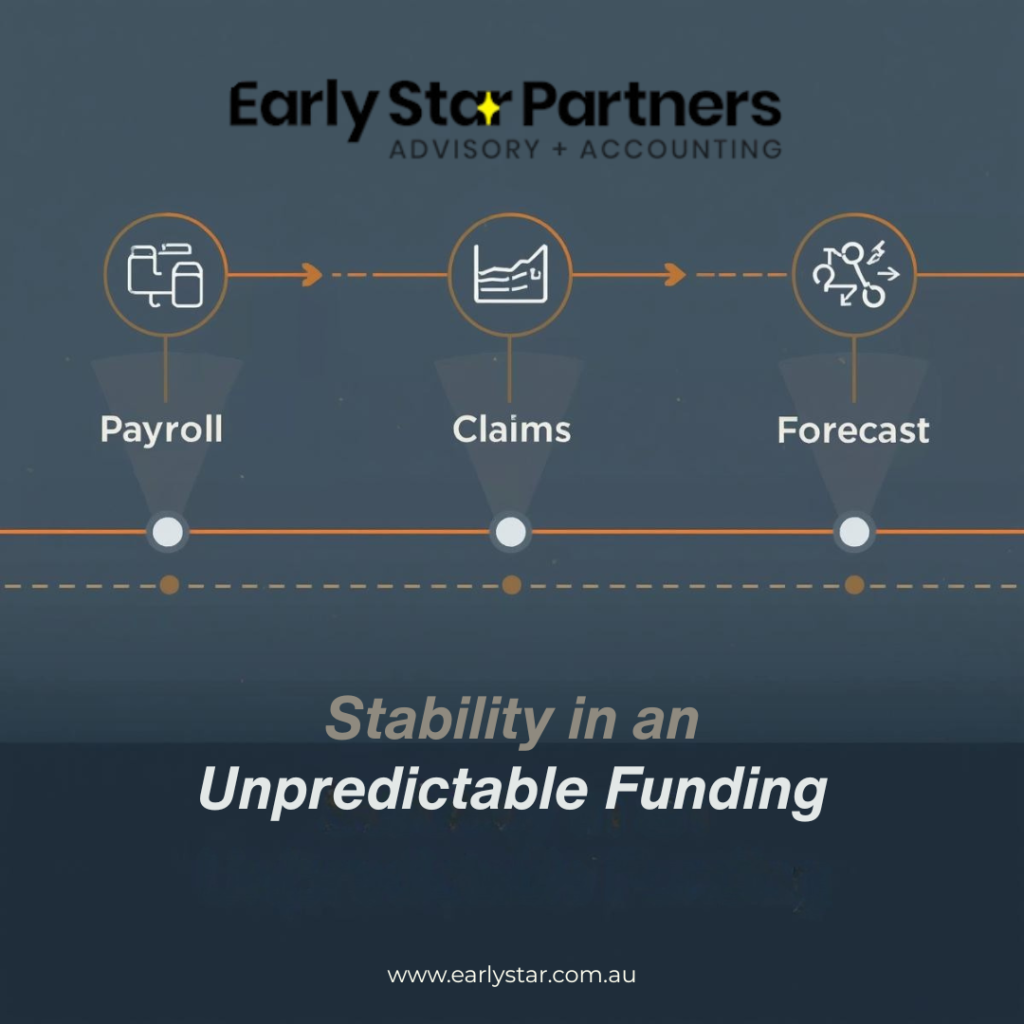
Operating as an NDIS provider in Australia comes with unique financial pressures. While demand for services remains strong, payment timing, claim processing delays, and compliance requirements can create serious cash flow strain. Many providers experience the same challenge: Revenue looks healthy on paper — but cash flow feels unpredictable. Why NDIS Cash Flow Feels Tight […]